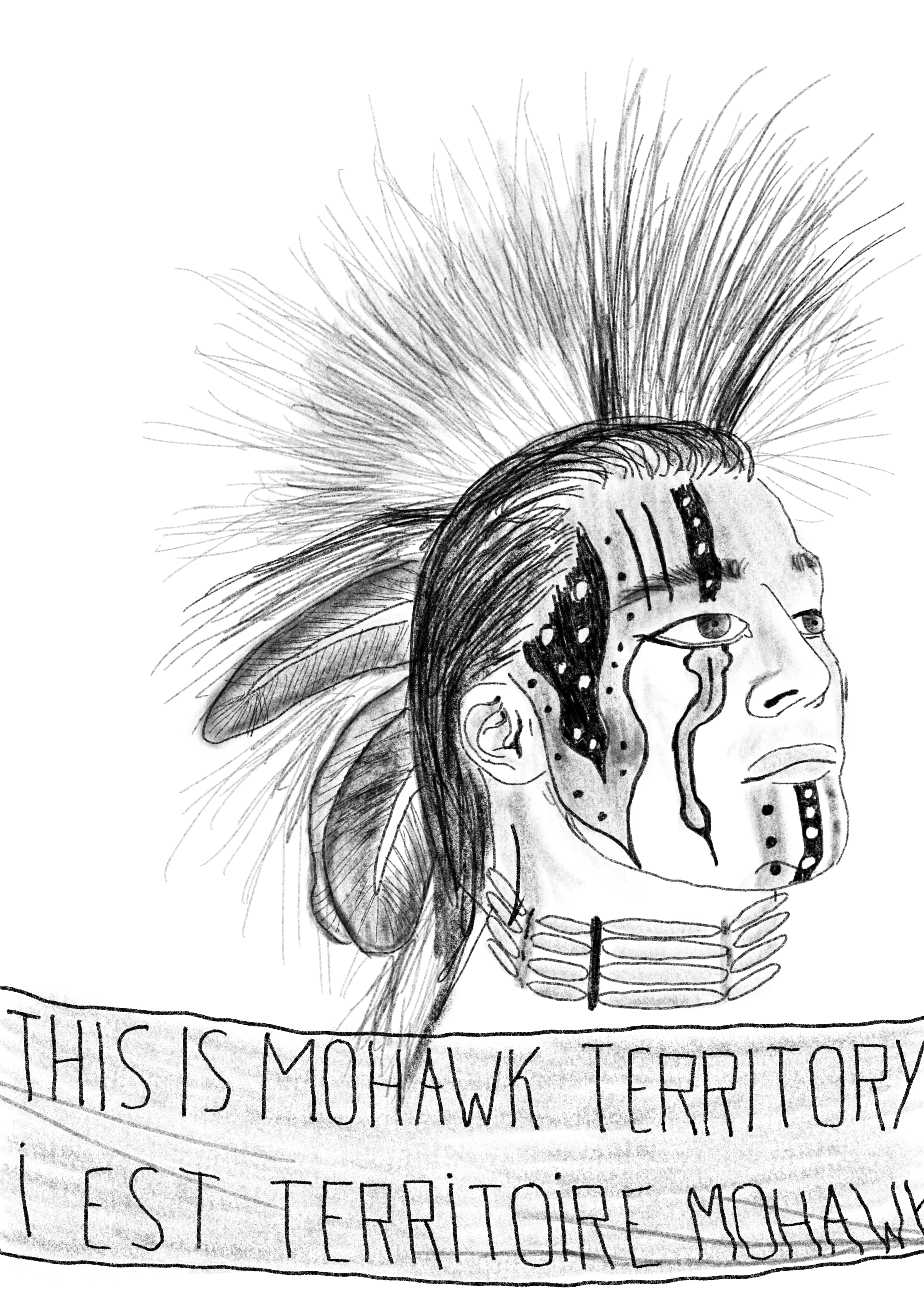
In 1990, the municipality of Oka, Quebec, created plans to expand the 9-hole golf course in the town. The outline consisted of nine additional holes and luxury apartments. All set to rest on what is referred to as “the Pines” by the Kanehsatake Mohawk people. That land was sacred to the Mohawk people, as it was where their ancestors were forcefully moved 270 years prior, after living in their village on what is now Montreal island by colonial France. The planned golf course was met with hostility and protest by the Mohawks and resulted in a 78 day siege that laid the groundwork for Indigenous resistance in Canada for the decades to come and was the subject of the documentary Kanehsatake: 270 Years of Resistance by Alanis Obomswain in 1993.
After a blockade began forming in March of 1990, the Kanehsatake people grew the barrier exponentially over the following four months.1 The Oka crisis began on July 11 of 1990, after the townspeople of Oka claimed it was an illegal occupation and pressure from local government swelled leading to a clash between the provincial police and the Kanehsatake people.1 A group of Mohawk warriors guard the blockade, they belong to the ‘Mohawk Warrior Society’. The provincial police, the Sûreté du Québec (‘SQ’) conducts a raid on the blockade after the townspeople's claim on the 11th. As the raid commences, gunfire rings out and plumes of tear gas shroud the blockade and the police raid is deemed a failure after an SQ officer is shot and killed. Provincial police retreated, leaving behind squad cars and bulldozers, which were later used to bolster the blockade by the Kanehsatake. The same day the Kahnawake Mohawks blocked the Mercier Bridge in solidarity, worsening the tension between the Mohawks and the nearby townspeople of Chateauguey and LaSalle, who were affected by the bridge blockade.
The bridge blockade resulted in the Kahnawake residents being cut off, nobody is allowed in or out.1 The next day an effigy of a Mohawk man is burned by the Chateauguey protestors, and some residents call them terrorists. The protests and counter-protests continued for the e Kanehsatake and bridge blockade. The SQ continued efforts to fight back against the blockades and resistance, and a crop of SQ blockades appeared, making travel in the area even more challenging. The Red Cross was briefly given permission to bring food to residents behind the blockade, but their access was quickly denied. Most food deliveries were deemed a security threat and not allowed to cross for most of the crisis.
At the same time the Mohawk people expanded their demands, asking for full sovereignty over their land.1 Surely an audacious ask, but understandable given that they sacrificed their original land centuries ago with the expectation that this land would not be impeded upon; their demands reflect a more deliberate promise compared to the previous expectations from the Mohawks.
It's still mid July, and the SQ requests RCMP involvement, and Quebec Premier Robert Bourassa calls on the Canadian Armed Forces for even more support.1 This resulted in the deployment of 4,000 soldiers around the Kanesatake and Kahnawake areas that were under Operation Salon.
As tensions rose during the conflict a convoy of Kanehsatake people feared a greater military assault was imminent.1 Amounting to 75 cars, carrying women, children and the elderly are attacked by a mob of Chateauguey protestors, stones are thrown and cars are badly damaged. A stone breaks a windscreen and kills an elderly man.
Outside of the nearby area and across the country Indigenous people came together in protest and action to support their fellow people.1 The story of Kanehsatake resonated with many as it is not just something that's happened once, but dozens of times before all over the country.
The documentary, Kanehsatake: 270 Years of Resistance, was made just three years after the crisis officially concluded. Obamswain, the director, hated guns but believed that "You can't resolve everything overnight but if you document it, a documentary is the best gun you can have.”2 Obamswain went on to make several more documentaries in the coming years and is one of Canada's greatest documentary filmmakers. The documentation of the crisis provides evidence and a bit of spectacle for the event and with groups all across the nation giving their support, the combination allows for radical change.
As the dust settled and the barricades removed, the federal government kept their end of the agreement and went through with the purchase of the land that the golf course and townhouse expansion were to be built.1 Additional plots were purchased for the people by the government but the land has not been officially designated a reserve.
No less than twenty years after Oka, the Coastal Gaslink pipeline was proposed and sought approvals from the BC government and various Indigenous groups. The owner of the pipeline, TC Energy began construction in 2018, even though it had not received permission from the Wetʼsuwetʼen hereditary chiefs. Eight years before the beginning of construction, barricades and checkpoints were set up along a development road by the Wetʼsuwetʼen, in response to the then Enbridge Pipeline setting up a camp right in the pipeline's path. When TC Energy receives their approvals in 2018, they request a formal court order from the Supreme Court of British Columbia to take down the barricades. There was a temporary injunction issued that December and the following year RCMP began a raid, enforcing the court order.
The RCMP arrested 14 Wetʼsuwetʼen ‘Land Defenders’, using snipers, helicopters and dozens of police vehicles. The RCMP set up a local detachment, claiming it is a ‘Community Industry Safety Office’. The Wetʼsuwetʼen maintained their presence along the road with the police still there, any protesters who entered the area faced arrest.
The Wetʼsuwetʼen took issue with the pipeline for a variety of reasons, principally environmental protections and community safety. The TC Energy company regularly did not comply with regulations. A number of violations took place having to do with erosion and sediment control. These violations have ramifications for a variety of habitats, notably on local fish habitats, which are vital to the local Indigenous communities.
Another issue is community safety, when these developments are carried out, there are a number of accommodations created for workers. These are called “man camps”, these camps are linked to the National Inquiry into Missing and Murdered Indigenous Women. Man camps are notorious for attracting transient individuals and commonly associated with debaucherous, drug and alcohol fueled, behavior.
In February 2020 TC Energy sought to get back to work, and the blockades made by the Wetʼsuwetʼen were taken down and 28 land defenders were arrested. At the same time several reporters along the road were detained, which is a clear violation of the freedom of the press. These arrests resulted in a number of solidarity protests across the country blocking passenger and freight traffic for weeks. Ultimately, these protests brought federal and provincial officials to the table to negotiate a solution that can work with both the Wetʼsuwetʼen people and the government. The officials and the hereditary chiefs could not come to an agreement. The negotiations resulted in a memorandum of understanding on the Wetʼsuwetʼen rights and title. However that did little in helping the cause of the Wetʼsuwetʼen, as the pipeline continued construction and with the encroaching pandemic the in person demonstrations and resistance halted. The pipeline was completed three years later in 2023.
Today, action hasn’t wavered on either side of the ‘blockade’, there has been a rise in residential school denialism, undermining efforts from Indigenous groups around the country. In 2021 it is reported that there is a potential mass grave site at a now defunct residential school in Saskatchewan, coming just weeks after similar reports of 215 remains of children were found in Kamloops. At the time these discoveries were stark reminders to the country of our past and brought forward national shame. In the years since there have been a number of reports of similar mass graves. However as the potential evidence began to rise, some believed it to be a hoax.
This year, just days before Truth and Reconciliation day a group of masked white nationalists held up signs with the phrase “Got Bones?” on a bridge in Kamloops. The group is suspected to be a part of the Second Sons of Canada, who on their website tout garbage like this:
“Will you watch passively as our way of life, our values, and our cultural heritage are defiled and erased or will you step forward, like the heroes of our past, like our grandfathers did, to safeguard and revitalize the essence of what it means to be Canadian?”3
Their values are quite ironic given they are disregarding and refusing to recognize a key part of Canada's past. There is an undeniable greatness of this country but like any, there are flaws. Those flaws include the forceful migrations of the Mohawks from Montreal island to the land that is now Oka, or the fact that when the Oka crisis first took place we still had residential schools operating in Canada, which would continue to run for over half a decade after the crisis ended. These kinds of actions by the Second Sons and other groups are done to debase the progress made since the Oka crisis and beyond.
What was meant to serve as an act to discredit the Indigenous communities became a moment of healing, as days after the white nationalists had their demonstration, a group of Indigenous people came together at the site and "cleansed" it. Action was taken by the local First Nation community, Tk'emlúps te Secwépemc, and enacted a zero tolerance policy for similar demonstrations.
While the Oka crisis is looked back on as a chaotic uprising that was a great success for the Mohawks, it is just one of many instances in our country's history that proves we have a population willing to fight tooth and nail for what they believe in.. While the beliefs of the are fueled by hate, ours should not be. It is important for all Canadians to step forward like the heroes of the past, like Alanis Obomswain or Brad “Freddy Kruger” Larocque the Mohawk warrior, following in their footsteps to keep the true essence of being Canadian alive.