When you hear the word “zombie” it is typically in the context of thriller or horror. The original individual is taken over and stripped of their free will, resulting in a mindless body that walks terrifyingly slow and feeds on the brains of the living. The concept makes for excellent folklore, and has inspired the antagonist of many novels and films.
But is this mind controlling behaviour and lack of consciousness such a stretch from fiction? Research shows that zombie-like creatures are closer to reality than expected.
In the game of life, the primary goal is to survive long enough to reproduce. Every organism is alive from a very long line of ancestors that successfully reproduced. The drive to reproduce has been naturally selected for because of this. Reproduction means that the genetics of a creature successfully lives on, and nature finds ways to do this by any means necessary.
Some organisms cannot survive or reproduce on their own. They must rely on a member from another species in hopes of living and reproducing. Organisms that exhibit this behaviour are known as parasites.
A parasitic relationship benefits the parasite and can cause negative side effects on the host. Parasites can vary from microscopic to large enough to see, but their defining feature is that they leech off another organism for survival.
For example, infectious bacteria enter a host to acquire critical nutrients, like sugars and amino acids.1 Tapeworms do not have a mouth or digestive system, and so they must also rely on absorbing nutrients through their skin from the food their host eats.2
That is enough to make skin crawl. Things get spookier when analyzing a subset of parasites that exhibit a trait called host manipulation, also known as zombie parasites. These parasites use clever biological mechanisms to alter the behaviour of the host organism, essentially controlling the mind of the host for their own benefit. This is best described with real world examples.
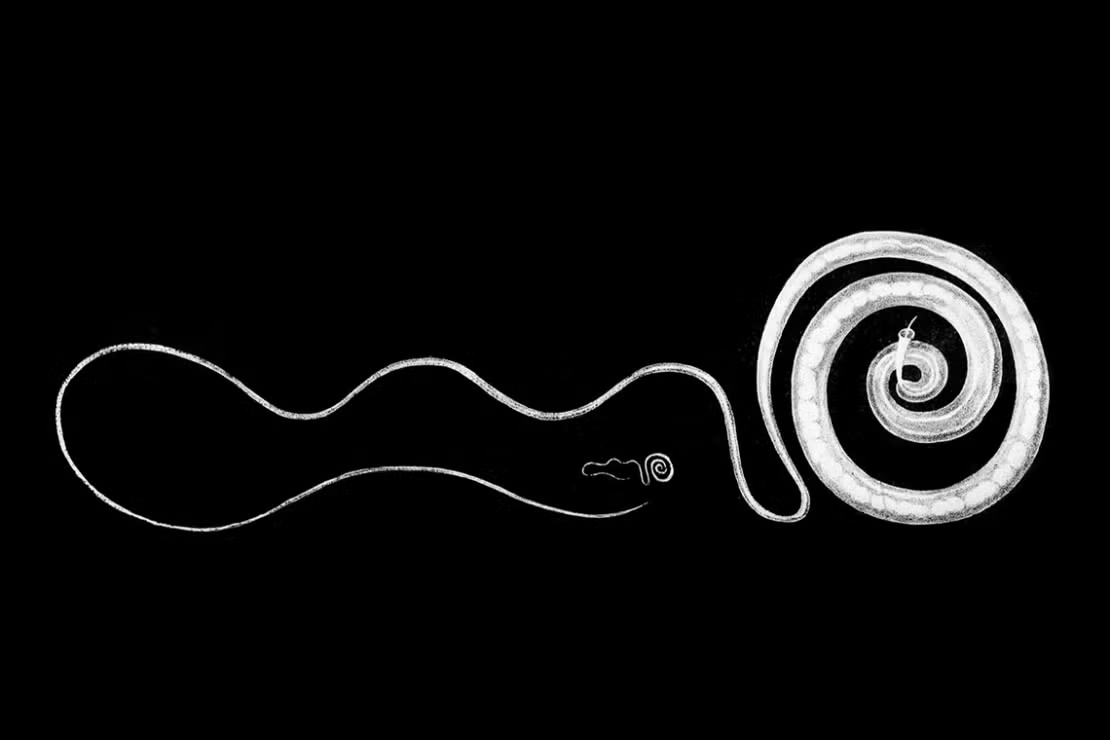
Nematomorpha – The horsehair worm
These worms require a host to complete their life cycle, which results in driving their host to suicide.3 The larvae can feebly survive until they are eaten by a host, such as a grasshopper or cricket. The larvae grow into their adult worm forms inside the host, feeding from the organism’s well earned nutrients.
After a few weeks, the parasite begins its full attack. It is believed that the horsehair worm activates genes inside the insect that attract it to water with horizontal polarization, much like the reflection off a pond’s surface.4 It has also been observed that the worm changes the circadian rhythm of certain hosts so that they are more active in the middle of the day, when it is easiest to find water.
The final piece in the life cycle is for the misfortunate insect to jump in water and drown themselves, allowing the worm to leave the host and swim to a spot to lay new eggs. The cycle continues, each rendition at the cost of the lives of the host insects.
Dicrocoelium dendriticum
This flatworm has a complex life cycle to find a target mammal host. To achieve this, the parasite’s journey involves multiple hosts. First, an egg is eaten by a snail and divides many times within the host snail’s body into larvae.5 The larvae exit the host via the mucus used for the snail’s movement.
The larvae are then eaten by ants, which become the second host. All larvae position themselves in the stomach, except one which travels to the ant’s brain. Hundreds of larvae could live inside one ant, simply waiting for the time the target host ingests them. The challenge is that ideal hosts like cattle and deer avoid ants on the ground.
This is where the worm positioned in the brain comes in: similar to the horsehair worms, this tapeworm changes the behaviour of host ants such that they climb up and clamp onto blades of grass.6
Impressively, the worm had to position itself very carefully in the ant’s brain for this mind control to work, targeting areas in the brain responsible for the ant’s jaw movements and motion.7
These are only a fraction of real world zombie parasites that live among us. Studying them can give insights into neuroscience and evolution. And fortunately, no such parasite has been known to affect humans. But it is important to note that in nature, there is a fine line between fiction and reality.