Over the course of the last few months, the province of Alberta has seen a political battle the likes of which has been otherwise unheard of in recent Canadian memory. Sparking from a teachers' strike, the ongoing clashes between Premier Danielle Smith and her governing United Conservative Party of Alberta (UCP) with the provincial New Democratic Party (NDP) has generated immense controversy, which may lead to the first NDP government to be formed in Alberta in over a decade.
The ongoing controversy is derived from the Alberta Teachers Association (ATA) after 51,000 members voted 95% in favour to go on strike this October 6th, with the commonly cited issues at task being a demand for class-size reduction, alongside better working conditions and a pay raise. Alberta's recent growth spurt, brought on by lower housing prices and taxes relative to the rest of Canada, has seen a considerable increase in families moving to the province, but not a corollary increase in funding towards education. As such, most classes have seen a stark increase in students as teachers have struggled to keep up. To remedy this, the ATA demanded an increase of benefits to bring more people into the profession, the hiring of more educational professionals, as well as a mandatory cap for how many people could attend a given class.
In response, the government provided a counter-offer to hire 1,000 more teachers by 2028, alongside an additional 1,500 educational assistants. It would also include a general 5% pay increase, among other miscellaneous benefits. That offer was rejected by 90% of teachers, with some claiming that it was practically identical to the original offer that led to the strike in the first place. Others criticized the increase in teachers as being roughly what the province had already planned with its new school constructions already underway. Further, most saw the 5% pay raise as being insufficient when paired with the inflation of the past several years.
Nevertheless, the government instated a back-to-work order through Bill 2, which forced the ATA to accept the aforementioned offer, and placed a ban on them from striking until August 2028. For a number of reasons, this bill was illegal, as the right to strike and arbitration is a legal right both in provincial and federal law, while also violating other various human rights laws at various levels of government.
As such, the bill was passed with the "notwithstanding clause," a legal tool which allows for legislatures to override roughly half of the Canadian Charter of Human Rights and Freedoms. Legally, therefore, the bill is sound, and cannot be overridden unless a provincial government seeks to undo the "deal" and implement a new deal later. Use of the notwithstanding clause has been controversial in most instances, and are accordingly very rare in order to minimize popular uproar. After all, the only time the province of Alberta had invoked it before now was in the year 2000, defining marriage as necessarily being between a man and a woman.
Yet the UCP has decided to invoke it another three times on top of the back-to-work order to pass an additional three bills since this November.
Last year, the UCP passed a bill known as Bill 26 to halt all gender-affirming care, including hormone therapy, gender-related surgeries, and puberty blockers for those under 16. That bill was blocked by a judge's injunction on the grounds of wanting to hear more information in court before approving it, though the UCP passed a bill with the notwithstanding clause that would place these enforcements into immediate effect, thus bypassing the judicial review of the courts.
Another bill the UCP passed, Bill 27, now forces all teachers to inform parents and/or legal guardians of children under 18 if students had changed their name or pronouns, and that any student under 16 interested in changing their pronouns needed parent or guardian permission before it would be respected by staff and teachers. It also now makes Alberta the first province to require students and parents to explicitly opt-in to sex-ed courses in order to attend, and the education minister is now responsible for approving all sexual health-related educational materials.
The third bill, the "Fairness and Safety in Sports Act," requires that all participants in female-only sports be assigned female at birth, including national or international sports events which may occur in Alberta. Furthermore, all three of these bills could be protected from repeal should Alberta pass Bill 9, which would ensure that all aforementioned bills cannot be challenged for nearly a decade.
The hands of the opposition are practically tied at this point, as the UCP has expressed an open willingness to use the notwithstanding clause, and more than enough MLAs are aligned with the party leadership to continue exercising this agenda. However, two different wildcards might threaten their government's continued stability and bring about an NDP government in Alberta even before the next general election.
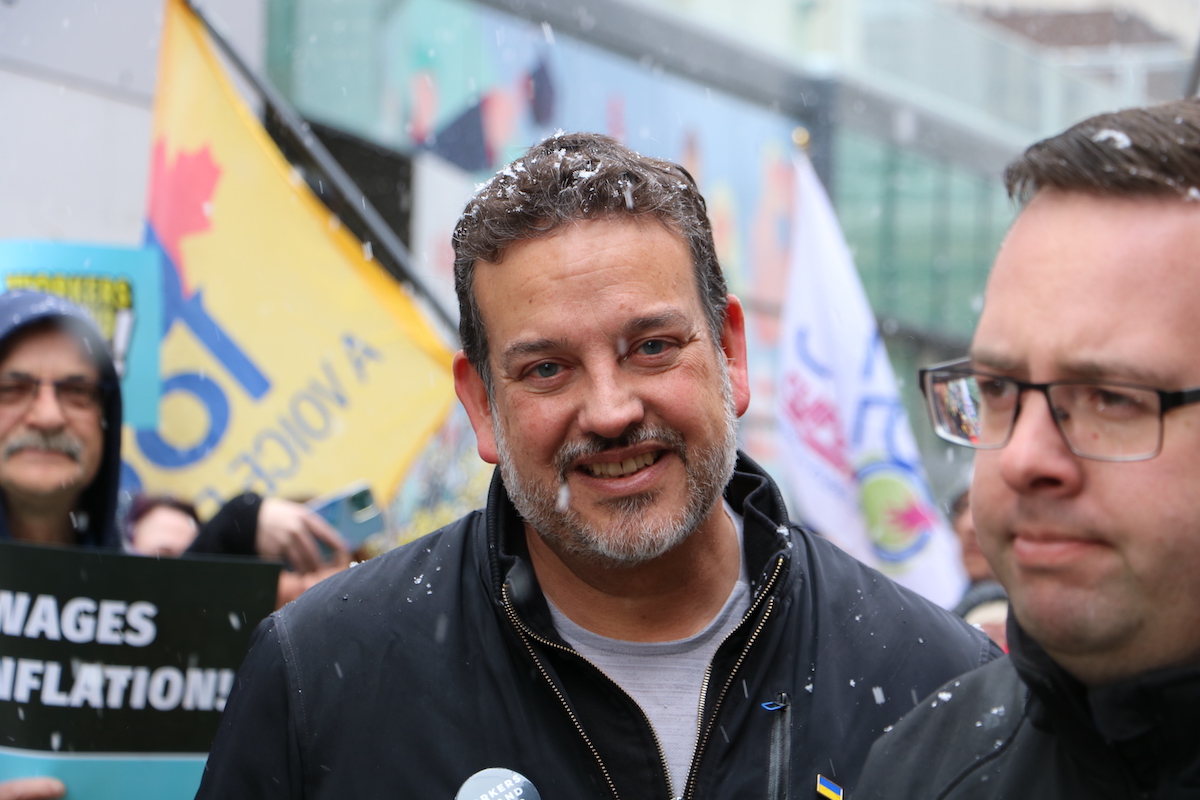
The Alberta Federation of Labour (AFL) has been, naturally, up in arms over the use of the notwithstanding clause regarding the forced ending of a strike. President Gil McGowan of the AFL has since organized with a variety of provincial labour unions to begin preparations to declare a general strike province-wide. On the political side, 15 campaigns have been started to hold recall elections for 15 UCP MLAs, including for the seat of Premier Smith herself. The NDP is six seats short of a majority government, and would need to win only four in order to form a coalition government with the centrist Alberta Party, should both parties be willing. As those recall petitions continue to collect signatures, and as deliberations of an all-out general strike continue to simmer, the province holds its breath in the face of what is very likely a wholly new political age.