On November 4th, 2026, dozens of students gathered in the UNC Ballroom to attend the Annual General Meeting (AGM) of the Students Union Okanagan (SUO). The AGM, held at the end of the first semester of each school year, offers students the opportunity to hear from their representatives, gain insights into the SUO’s activities over the past year, and vote on a variety of pressing issues.
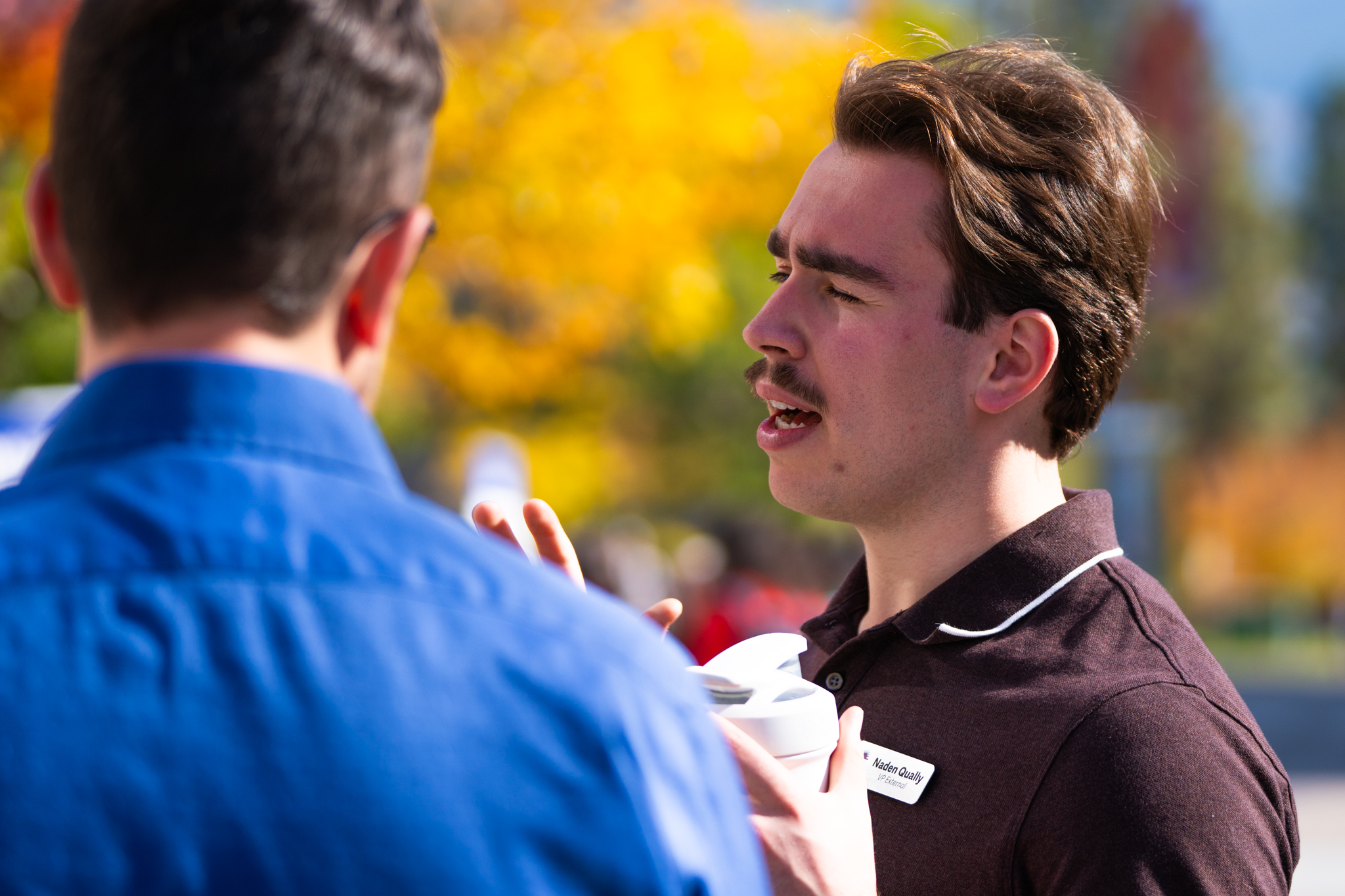
Present at the AGM were Olivia Lai, Naden Qually, Shreya Patnaik, Quinlin Osadczuk, and Guransh Sandhu. The meeting was chaired by Michael Gauld, a UBCO Alumnus and current Director of Membership Development for the BC Federation of Students.
Prior to advancing to the scheduled agenda, two requests for amendments were raised. The first proposed the introduction of a new bylaw regarding the usage and circulation of artificial intelligence (AI) by the SUO. The second involved providing students with an update on appendix B of the previous year’s resolution concerning UBC’s commitment to divesting from Israel. As students filled the ballroom, leaflets were distributed with details about these resolutions in order to ensure they were well-informed about the content of these proposals.
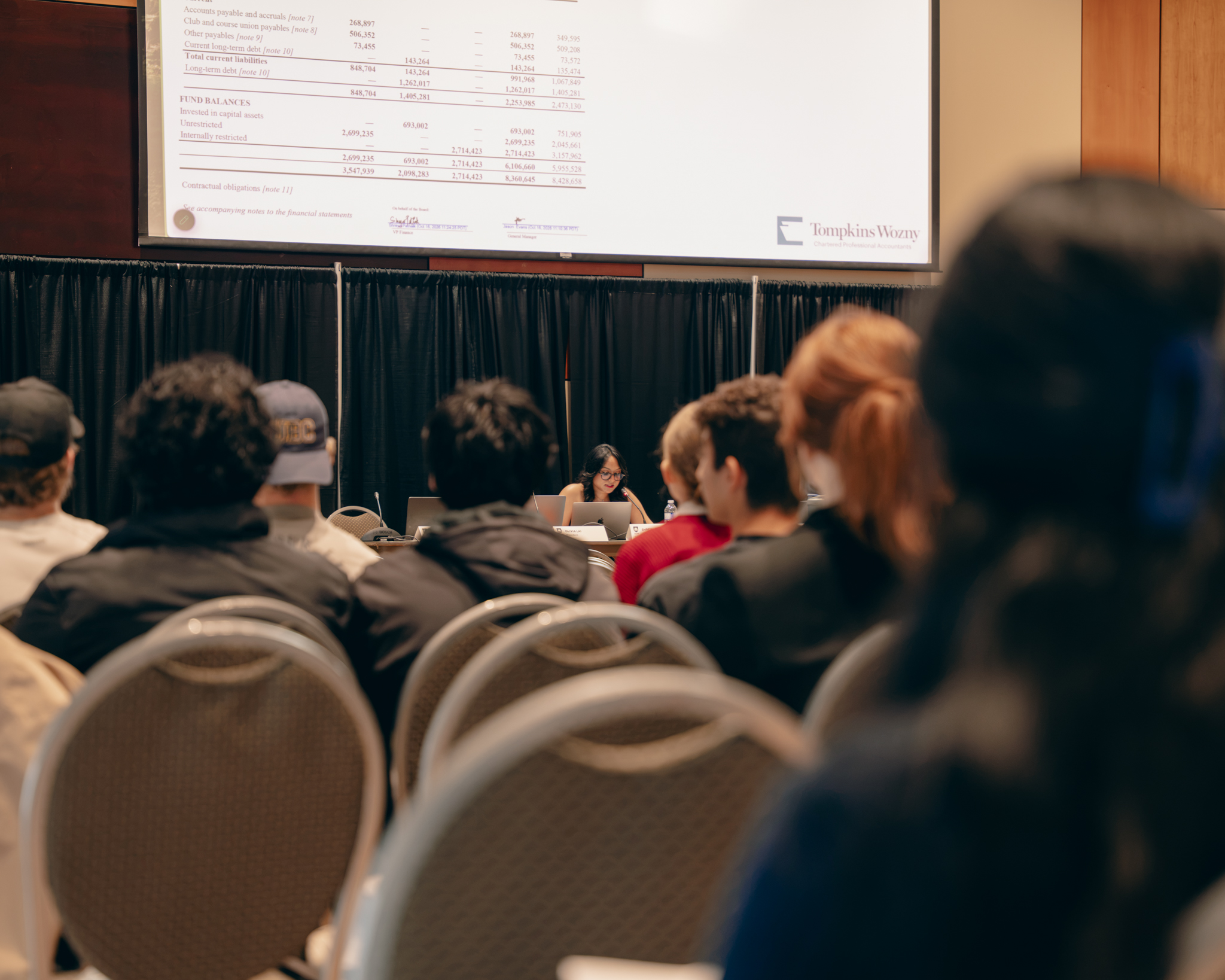
Before further discussion, the SUO presented its annual audit report for the 2025-2026 academic year. Vice-President of Finance and Administration Shreya Patnaik proudly announced the SUO’s clean audit.
The audit report, accessible to students online, included a range of categories related to the SUO’s assets, liabilities, revenue, and expenses. A particular point of concern was the funding allocated towards services that directly benefit students such as Pantry and other food services, the bookstore, and student services. All these areas saw a mild to significant decrease from 2025 to 2026.
Addressing Pantry and other food insecurity initiatives on campus, Patnaik clarified that the reduction in funding was attributed to secured agreements for purchasing food at lower prices and that students still enjoyed the same amount of services. However, she also acknowledged that lower wages for staff and volunteers at Pantry were a contributing factor to the overall decline in funding. While students may still be receiving the same amount of services with the funding reduction, it comes at the expense of those who make these programs possible. Furthermore, it remains unclear why the salaries of the SUO’s Vice Presidents increased concurrently with a reduction in wages for Pantry staff, especially given that food and materials had been acquired at a lower price.
Following this presentation, the first request to amend the agenda was put forth, which centered on a resolution regarding the transparency and utilization of AI by the SUO.
The first resolution called for the SUO to be more transparent about its use of AI. The motion stated that “the use of Generative AI for advertising, communication, and board operations inherently violates the regulation item about attribution credit, as not publicly disclosing SUO content that is generated or manipulated with Generative AI is equivalent to not attributing credit to the source of the content, committing plagiarism or patch-writing.”
To address these issues, the resolution requested that the SUO “clearly flag and label any SUO content and communication created using Generative AI as ‘AI Generated’ or ‘AI Manipulated.’”
The motion received overwhelming support from those in attendance, as the prevalence of AI has been a pressing issue among universities, with UBCO being no exception. Recently, the by-elections attracted criticism on social media due to the widespread presence of AI-generated campaign posters scattered around campus, raising concerns about the lack of personal involvement in advocacy and campaigning.
While Resolution 1 called for any usage of AI by the SUO to be clearly communicated to students, Resolution 2 aimed to prohibit any use of AI by the SUO in its official operations.
The rationale behind the second resolution argued that utilizing AI was “unethical,” as it undermines “artistic endeavors” and reduces opportunities for students to showcase their creative abilities and participation in their student union. It further criticized the use of student fees for processes with questionable ethical and environmental implications as a betrayal of students’ trust.
Ultimately, the resolution called for the adoption of AI regulations that would entirely prohibit SUO members from using Generative AI for “all communication channels of the SUO, such as emails, public statements, social media content, website information, posters, and minutes.”
Despite the general support for the motion, Olivia Lai expressed concerns about both resolutions. She highlighted that Generative AI poses a significant challenge to post-secondary institutions that would be difficult for the SUO to regulate. Additionally, she noted the support and use of AI by numerous institutions as a potential issue with carrying out this request.
Lai also suggested an amendment to the second resolution, specifically objecting to the use of the word “prohibited” as being ”quite strong.” She further conveyed her reservations concerning an outright ban on AI use, citing potential long-term costs and the uncertain direction of AI within post-secondary education. However, attendees quickly defeated this amendment, and the assembly passed both resolutions with the support of a majority of voters.
The next amendment came from UBCO’s divestment group, which asked for an update on last year's resolution calling for the SUO to put pressure on UBC officials to “publicly post an updated and concrete timeline regarding the development of a Human rights Framework by UBC Investment management.”
The motion called for the SUO to “pen a letter addressed to UBC President Benoit-Antoine Bacon, Deputy Vice-Chancellor and Principal Lesley Cormack, and the UBC Okanagan Senate demanding that UBC cancel all current student mobility agreements with institutions upholding apartheid, including Hebrew University of Jerusalem, Technion – Israel Institute of Technology, and Tel Aviv University, and that a moratorium is placed on student mobility agreements with Israeli Universities until the UN removes the classification of Israel as an apartheid state.”
In addition to this update, they asked the SUO to sever its ties with the list of companies identified in the UN Human Rights report that are currently profiting from and investing in the ongoing humanitarian crisis in Palestine. Furthermore, they requested the SUO continue to advocate for these policies with the UBCO Senate, maintain open lines of communication with the student body and publish updates, details and information on their official website and social media.
The SUO was originally requested to discuss these matters with the Board of Governors within seven days of the AGM; however, due to the complexity of this task, they negotiated an extension of the window to 14 days.
After these amendments to the agenda were discussed, VP Internal Quinlin Osadczuk moved on to present the three by-law amendments outlined in the meeting agenda.
The first proposed by-law amendment sought to establish an Indigenous Student Representative on the SUO Board of Directors. Osadczuk and the meeting agenda clarified that candidates wishing to run for this position would need to complete a Self-Identification form to declare their specific identity and status. Although only individuals identifying as Indigenous would be eligible to run for this position, all members of the student body would have the ability to vote due to privacy issues surrounding the collection of students' personal information.
The responsibilities associated with this role include serving as a liaison between Indigenous students and the Board in order to identify and address any concerns or challenges faced by the Indigenous student body. Additionally, this representative will be an Indigenous voice and perspective to discussions and initiative, collaborate with the SUO Indigenous Peoples Collective and other Students’ Union representatives and organizations on Indigenous Peoples’ advocacy, and assist with “the planning and implementation of Students’ Union campaigns, events, and initiatives.”
The proposed second by-law aimed to enhance the duties of Faculty Representatives by requiring them to attend the Annual General Meeting of their respective course unions to the best of their abilities.
Following support from audience members for these two resolutions, they were passed. Attention subsequently shifted to what Quinlin Osadczuk referred to as the “big one.”
The final proposed by-law amendment sought to change the format of the election system used by the SUO for its elections and referenda, specifically calling for a transition from a First-Past-The-Post (FPTP) to a Ranked-Choice Voting system.
Ranked-Choice Voting would allow students to rank one or more candidates in an election; however, as clarified, it would be optional to rank every candidate. Elections would utilize either Instant-Runoff Voting or Single-Transferable Vote depending on the number of candidates running in order to determine the outcome.
As explained in the leaflet distributed to attendees, this initiative aims to “make elections more fair, give voters more choice and make elections more accessible.” The leaflet further highlighted several shortcomings of a FPTP voting system, highlighting that offering only one option may pressure voters to select a candidate they believe have a greater likelihood to win, rather than who they would really like to vote for.
Another major limitation of FPTP is that a candidate may be elected without receiving a majority of the votes, which creates concerns surrounding accurate representation.
The proposed voting system is designed to allow more selection and variability for voters, giving them the chance to rank candidates until one of them receives a majority of votes. The leaflet also cited the successful implementation of RCV in other universities and countries such as Australia, New Zealand, and Scotland.
After an in-depth discussion and clarification regarding the advantages of Ranked-Choice Voting and its potential effects on future elections, the change received majority support and was subsequently passed.
The adoption of these by-law resolutions represents a major win for the student body. Not only will the individual roles and responsibilities of the SUO Board of Directors and Faculty Representatives be modified to better reflect the needs of specific groups of students, but the implementation of Ranked Choice Voting will foster more democratic and accessible electoral processes in the future.
With all bylaw changes addressed, the members of the SUO closed up the meeting by presenting the 2026/2027 Budget, the General Manager Report, Executive Committee Report, and the Campus Life, Campaigns, Oversight and Policy Committees Reports.
Although much of the content of these reports centered around last year's executives, thereby limiting chances for further inquiries and comments, Olivia Lai, speaking for the Executive Committee Report, commented on many of the SUOs' achievements last year. She specifically highlighted the successful U-Pass referendum, initiatives to mitigate food insecurity and keep costs down for the health and dental plan, as well as efforts to strengthen "governance and accountability,” for board members.
As the AGM approached its end, the executives outlined their objectives for the upcoming academic year. These goals emphasized a heightened focus on mental health through campaigns during exam periods, collaboration with other student unions, and the continuation of initiatives aimed at bolstering food security on campus and supporting students facing financial challenges, such as housing.
Overall, the AGM was a great opportunity for students to voice their concerns and vote on new amendments directly impacting them. With a multitude of new by-laws passed, only time will tell how the SUO implements them into official policies.